





Hundreds of special baskets filled with recycled oyster shells are creating a ‘living filter’ in the Pine River, giving the local ecosystem near Murrumba Downs and Griffin a much-needed boost.
The project, a first of its kind for Australia, began almost two years ago. It is a team effort between Unitywater, the University of the Sunshine Coast (UniSC), OzFish, and Healthy Land and Water. The main goal is to see if shellfish reefs can naturally filter and reduce nutrients flowing into the waterway from the Murrumba Downs Wastewater Treatment Plant.
A ‘Living Filter’ Built by Volunteers
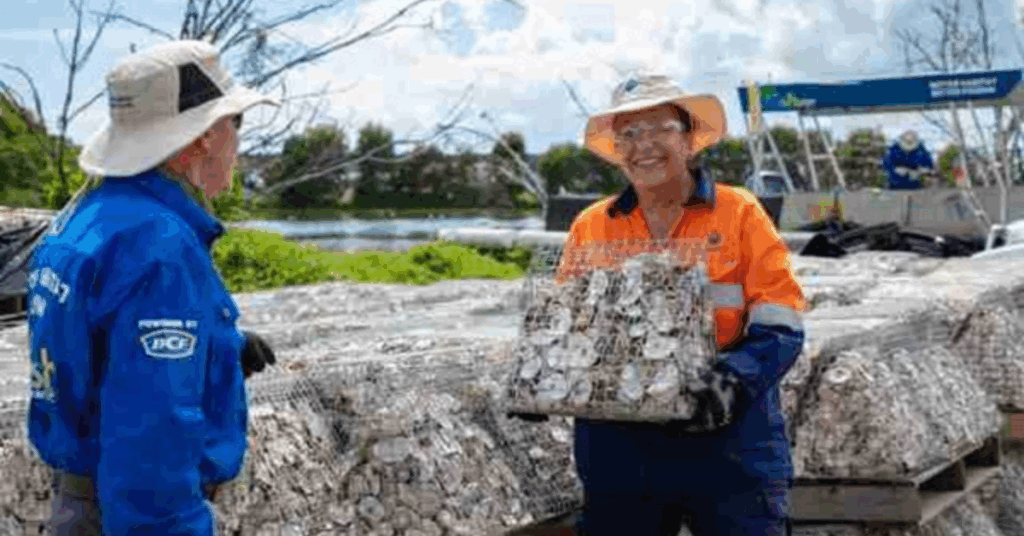
These new reefs are not grown entirely from scratch. Instead, they are built using special oyster baskets packed by OzFish volunteers. Each basket is filled with about 18 kilograms of oyster shells that have been recycled from local restaurants and commercial kitchens.
Before they can be placed in the river, the shells are left out in the sun for a full year. This process cleans them of any grit or sand. After cleaning, they are prepared for tiny young oysters, called spat, to attach before the baskets are installed in the riverbed.
Nature’s Hardest Workers
Once in the water, the shellfish get to work. According to Unitywater’s Mike Basterfield, the project measures success by checking the shellfish and the sediment around them. The oysters act as powerful natural filters, cleaning the water as they feed. They absorb nutrients like nitrogen, using it to grow their own bodies and shells, which locks those nutrients away so they don’t re-enter the waterway.
In the first six months of measuring, the trial reefs managed to remove a total of 7.24 kilograms of nitrogen from the water. Early results show just how powerful this idea could be. Mr Basterfield explained that a larger system of about 154 reefs, covering an area roughly the size of two rugby league fields, might be able to completely offset the nitrogen from a plant that services 10,000 people.
Restoring a Lost Ecosystem

This work is vital for the local environment. UniSC marine ecology expert, Associate Professor Ben Gilby, stated that Australia has lost more than 95 per cent of its natural shellfish reefs due to overharvesting and other human activities.
Historically, these reefs played a huge part in keeping waterways clean. Dr. Gilby’s team has confirmed the trial reef is successfully filtering the water, improving its quality, and storing nutrients. This finding is a significant boost for future restoration projects.
What’s Next for the Pine River
Following these positive results, the trial is set to grow. Unitywater has received approval to install two more reefs in the North Pine River, in the area between Lawnton and Murrumba Downs.
Mr Basterfield said these new sites will help the team test how well the reefs work in different conditions, such as different water depths and salt levels. This will provide a clearer picture of how to scale up the solution. The project is a key part of Unitywater’s goal to divert or offset all nutrients from wastewater by 2040, using innovative, nature-based solutions.
Published Date 04-November-2025