




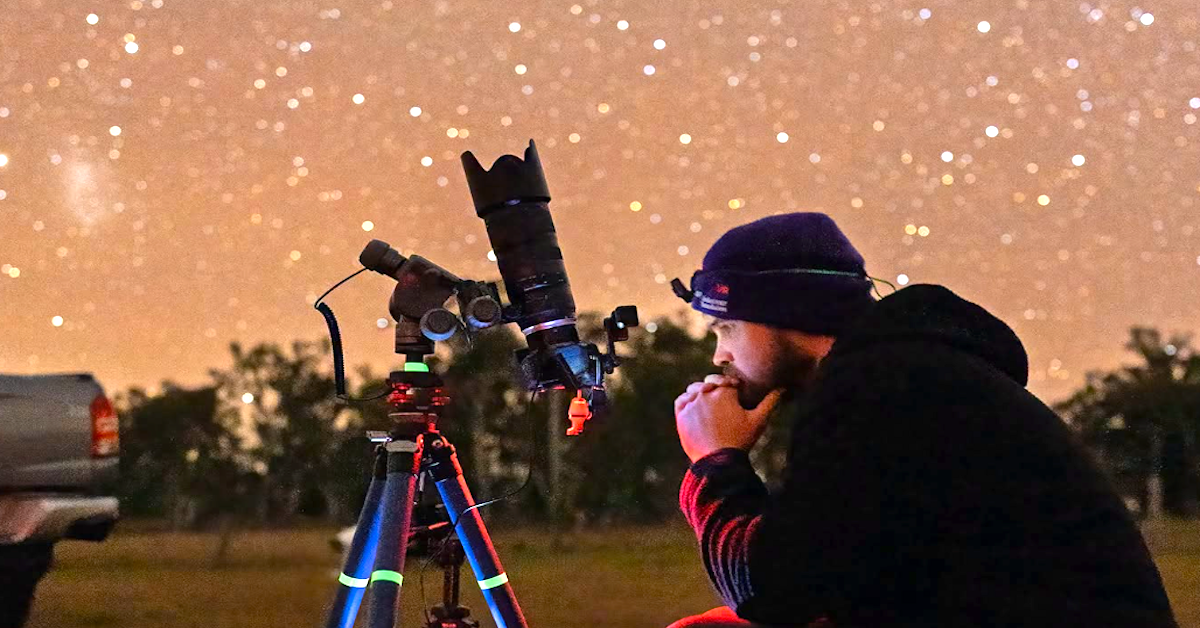
A first look at the Moon through a telescope can reveal a landscape of craters, mountains and shadows that is impossible to appreciate with the naked eye.
Bracken Ridge families will have an opportunity to discover those details when volunteer astronomers from the South East Queensland Astronomical Society (SEQAS) bring their telescopes to Barrett Street Park on Saturday, 14 November.
The free evening is part of the society’s Urban Observers programme, which gives beginners and experienced skywatchers a chance to explore astronomy together. Running from 5:00 pm to 10:00 pm, the gathering requires no bookings or specialist equipment.
The Moon Through a Different Lens
The Moon is likely to be one of the evening’s most accessible attractions.
On 14 November, it will be a waxing crescent, with roughly one-fifth of its visible surface illuminated. Along the boundary between its bright and dark regions, sunlight casts shadows that make craters and other features easier to distinguish.
Saturn is another possible target in the November evening sky. Through a suitable telescope, its famous rings can appear as a delicate structure around the planet, although the quality of the view depends on the equipment and atmospheric conditions.
Visitors may also learn about star clusters, where stars appear grouped together, and nebulae, the enormous clouds of gas and dust found throughout space.
These objects often look quite different through an ordinary telescope from the colourful photographs produced by space observatories. Some appear as faint patches of light, while others require darker skies or specialised imaging equipment to reveal their finer details.
What visitors actually observe will depend on the weather, visibility and the telescopes available on the night.
A Local Tradition Under the Stars
SEQAS has been sharing its enthusiasm for astronomy since 1989, when the society was established to encourage the study and appreciation of the night sky.
Its connection with Bracken Ridge extends beyond occasional public events. The society holds regular meetings at Bracken Ridge Library, while Barrett Street Park has become an established gathering place for its Urban Observers programme.
The monthly sessions are generally scheduled around the Moon’s first-quarter phase, when the contrast between sunlight and shadow makes lunar features particularly rewarding to observe.
Rather than requiring families to travel far beyond Brisbane’s suburban lights, the programme brings astronomy into a familiar community setting.
The society’s members share their equipment and knowledge, helping newcomers identify objects, understand how telescopes work and develop the confidence to explore the sky themselves.
Bringing a Telescope Out of the Cupboard
Visitors do not need to own a telescope, but those who already have one are encouraged to bring it along.
SEQAS volunteers can help with setting up equipment, adjusting its alignment and understanding the controls. They can also assist with collimation, the process of aligning a telescope’s optical components to produce a clearer image.
Different instruments offer different experiences. Refracting telescopes use lenses to gather light, while reflecting telescopes use mirrors. Both can provide rewarding views of the Moon and brighter celestial objects.
The society also has experience with electronically assisted astronomy, which uses cameras and digital processing to reveal objects that may otherwise be difficult to distinguish under suburban skies.
For newcomers, having someone nearby who understands the equipment can make the difference between struggling to locate an object and enjoying that first clear view.
An Evening for Curious Minds
The session begins at 5:00 pm, while daylight remains. This gives visitors time to meet the volunteers, ask questions and become familiar with the telescopes before the sky darkens.
Barrett Street Park is accessible via Jude Street, with free parking available. SEQAS recommends bringing a camp chair, warm clothing and, if available, a red-light torch, which helps preserve night vision.
Although suburban lighting limits views of faint objects, the Moon, bright planets and some star clusters can still provide worthwhile observing opportunities.
The event is weather-dependent. SEQAS advises visitors to check its Facebook page from 4:00 pm on 14 November for confirmation that the gathering will proceed.
Admission is free, bookings are unnecessary and families can simply turn up.
For those who have wondered what lies beyond the familiar stars above Bracken Ridge, the evening offers a chance to explore with people who have spent years learning where to look.
Published 30-Oct-2026