




By Jack Mercer – Rabbit Hole Fisherman
A doctor’s request to film a beating heart led Ron Jones towards a mechanism that would become part of IMAX. The route ran through a Brisbane cinema, a patent office and an international experiment in how big a movie could be.
In This Story
- The problem with moving pictures
- The first idea
- From Brisbane to IMAX
- Making it work at film speed
- A new cinema experience
A human heart helped set this story in motion.
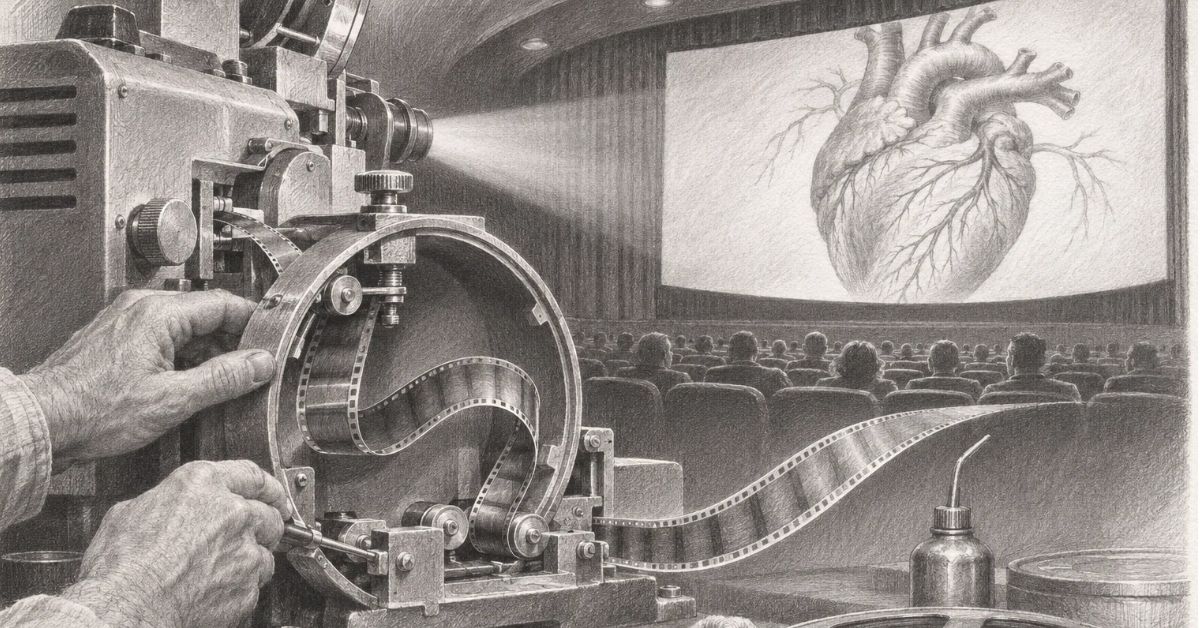
In 1964, Dr Jim Hood at Chermside Hospital wanted to make an X-ray film of a beating heart that could be studied in slow motion. That meant recording the action fast enough to reveal what ordinary viewing could miss. It also meant moving film through a camera at a speed that presented a difficult mechanical problem.
Hood asked his friend Ron Jones for help.
Jones was a Brisbane engineer who repaired and improved cinema projection equipment. He understood the machinery behind a picture on a screen, including the trouble that could begin when a strip of film was asked to move too quickly.
The hospital connection was later recorded in Queensland Parliament. In November 1998, Premier Peter Beattie described Hood’s request while announcing the site launch of an IMAX theatre at South Bank. A development being celebrated beside the river had an earlier connection to a hospital on Brisbane’s northside.
The problem with moving pictures
By then, Jones’s invention had travelled a great deal further.
Film projection depends on a peculiar arrangement: the strip has to move, but each picture must stop briefly in the right place to be shown. Then the next picture takes its turn.
At ordinary cinema speed, that happens 24 times a second. Making the picture on the film much larger makes the transport problem harder. There is more film to move through the machine between exposures, and the material has limits. The holes along its edges can tear. A picture that shifts in the gate will shift on the screen.
Jones developed a mechanism called the rolling loop.
His patent describes film passing between a stationary surface and a moving one. Gaps in the moving surface accommodate loops of film. As those loops travel through the mechanism, they allow successive sections of the strip to advance, while locating pins hold a frame briefly in position at the aperture.
The loop provides room for film that keeps arriving while part of the strip has stopped. It is a way to reconcile steady feeding with the stop-start business of showing individual pictures.
The paperwork gives the inventor’s full name: Peter Ronald Wright Jones. The Australian priority date recorded for the invention is 18 April 1966. His US patent was granted in February 1970.
The first idea
Queensland Museum’s account places the initial insight earlier, in 1964. It says the idea came to Jones while he was driving home in heavy traffic and that he had verified the basic concept by noon the following day.
That is an appealing invention story, but a working cinema demanded more than an afternoon’s inspiration. The mechanism had to move actual film, repeatedly, with a picture steady enough for people to watch.
A version ran at Brisbane’s Eldorado cinema.
From Brisbane to IMAX
Across the Pacific, filmmakers were wrestling with the possibilities of much larger images. The Canadian team that developed IMAX included Graeme Ferguson, Roman Kroitor and Robert Kerr, with engineer William Shaw joining the enterprise.
They needed a practical way to transport the film for their ambitious format.
In a 1997 interview with Take One, Ferguson recalled that Jean-Philippe Carson had spotted a short published description of the Australian invention. Carson and Kerr contacted Jones, then flew to Brisbane to acquire the patent rights.
Ferguson’s recollection gives the transaction an unexpectedly domestic detail. Jones had a particular sum in mind because he wanted to build a small house in the hills. The buyers were short of money and paid over time. Jones continued helping as a consultant.
The purchase gave the team a mechanism to develop. Scaling it up remained a substantial engineering job.
Making it work at film speed
In accounts preserved in Graeme Ferguson: A Filmmaker’s Journey, Shaw described experimenting with parts from a Gestetner duplicating machine. A trial mechanism ran in his garage at half the required speed and still occasionally lost the frame position.
That was nowhere near good enough for a public screening.
Shaw also explained that doubling the speed made the dynamics four times as difficult. A prototype that behaved reasonably well at 12 frames a second could not simply be turned up to 24 and pronounced finished.
Ferguson recalled Jones being commissioned to build an adjustable prototype for the larger format. The immediate requirement was basic: advance the film without ripping it.
Shaw’s later patent records some of the work needed to achieve reliable operation. It explicitly identifies Jones’s earlier rolling-loop mechanism, then describes improvements including compressed-air cushioning and a system to slow the film onto its locating pins.
Those documents preserve the contributions of two engineers. Jones supplied the original rolling-loop invention; Shaw developed improvements for the large-format machine.
A new cinema experience
On 15 March 1970, Tiger Child premiered at the Fuji Group Pavilion at Expo ’70 in Osaka. IMAX’s own record lists the film at 17 minutes. A mechanical idea developed in Brisbane had become part of the equipment behind a new cinema experience in Japan.
Nearly three decades later, Beattie’s statement to Parliament brought the connection back to local streets and buildings. The Eldorado had already provided a working home for Jones’s mechanism before the rights were bought.
It is a useful detail to carry into an old cinema: behind the screen, beyond the seats, someone had been working out how to make the pictures move differently.
And before that, a doctor had wanted a better look at a beating heart.